
Summary
- Trove is credit control software for growing UK finance teams. Trove keeps every email, reply, note and approval against the customer, which gives you an answer when an auditor says “show me you’ve chased this”.
- Auditors test that trade debtors exist, are recoverable and are complete, and that sales and credit notes sit in the right year.
- Have five things ready before fieldwork: an aged debtors list that agrees to the ledger, a reason and evidence for every old balance, a provision method you can explain, a list of post year-end receipts and credit notes, and customer contacts in case the auditors send confirmations.
- A bad debt provision under FRS 102 needs objective evidence that a loss has already happened. A flat percentage of the whole ledger doesn’t meet that test.
- Chase old balances in the six weeks before year end. Every balance you collect is one you don’t have to explain or provide for.
What auditors test on trade debtors
Auditors work through a set of assertions defined in ISA 315, which are claims your accounts make about each balance. For trade debtors, four of them drive most of the questions you’ll get.
| What they test | In plain words | What they'll ask you for |
|---|---|---|
| Existence | These customers are real and owe this money | Invoices, proof of delivery, customer confirmations, cash received after year end |
| Valuation (recoverability) | You'll collect what the balance sheet says | The aged list, your provision working, the story behind old balances |
| Completeness | Nothing that should be on the ledger is missing | The ledger reconciled to the control account, orders and despatches traced to invoices |
| Cut-off | Sales and credit notes are in the right year | Despatch records either side of year end, credit notes raised after it |
Your auditors decide the exact tests, based on their assessment of risk. This checklist gets your side ready, whatever they pick.
The checklist: ten checks with how to verify each
Here’s the whole list on one screen. The detail for each check follows.
| Check | How to verify | Evidence to keep |
|---|---|---|
| 1. Aged list agrees to the ledger | Agree the aged total to the debtors control account at year end | Dated report and signed reconciliation |
| 2. Old balances explained | Write one line for every balance past your cut-off age | Latest correspondence and the next action |
| 3. Provision method | Re-run the method on last year's figures and compare with what happened | Method note and working |
| 4. Specific provisions | Link each one to an event that has already happened | Insolvency notices, administrator reports, correspondence |
| 5. Post year-end receipts | Match cash received after year end to year-end invoices | Receipts list tied to bank statements |
| 6. Credit notes after year end | List them and decide which relate to the year just closed | Credit note list with reasons |
| 7. Customer confirmations | Check the named contact and address for your largest balances | Contact list, invoices and delivery records |
| 8. Disputed balances | List each dispute with amount, cause and owner | Dispute log and customer emails |
| 9. Related-party and intercompany balances | Agree each balance to the other company's ledger | Signed balance agreements |
| 10. Evidence of chasing | Pull the history for your ten oldest balances | Emails, replies, call notes and approvals |
1. The aged debtors list agrees to the ledger
Ask: Does the aged list at year end add up to the debtors figure in the trial balance?
Why it matters: Every other test starts from this list. If it doesn’t agree, the auditors can’t rely on anything sampled from it.
How to verify: Run the report dated at year end, not on the day you happen to open it. Agree the total to the control account and explain any difference line by line. If you need a refresher on the bands, here’s how to read an aged receivables report.
Evidence to keep: The dated report as an export, and the reconciliation with the preparer’s and reviewer’s names on it.
2. Every old balance has an explanation
Ask: Why is this still unpaid, and do you expect to collect it?
Why it matters: Age is the first thing an auditor looks at when judging recoverability. “We’re chasing it” won’t carry a balance that’s six months old.
How to verify: Pick a cut-off, such as 90 days overdue, and write one line per balance: the reason, the last contact, the next step and whether you expect payment in full.
Evidence to keep: The most recent email or call note for each balance, plus any promised payment date.
3. You can explain your provision method
Ask: How did you arrive at the provision, and has the method worked in the past?
Why it matters: A bad debt provision is an estimate, so the auditors will test the thinking behind it as well as the arithmetic.
How to verify: Apply your method to last year’s closing ledger and compare the result with what you actually lost. A method that’s been badly wrong needs changing before they point it out.
Evidence to keep: A short method note, the working, and last year’s comparison.
4. Specific provisions link to a real event
Ask: What happened to this customer that makes this balance doubtful?
Why it matters: FRS 102 paragraphs 11.21 and 11.22 require objective evidence of impairment, such as a customer in significant financial difficulty, a default, or probable insolvency.
How to verify: Match each specific provision to a dated event. If a customer goes into administration after year end, read our guide to what to do when a customer enters administration, and tell your auditors, because it can be evidence of a loss that already existed.
Evidence to keep: Insolvency notices, administrators’ reports, and the emails that show the customer’s position.
5. Post year-end receipts are listed
Ask: How much of the year-end balance has been paid since?
Why it matters: Cash after year end is some of the strongest evidence you have. It shows the debt existed and was collectable, and it’s what auditors often turn to when a customer doesn’t answer a confirmation.
How to verify: Export receipts from year end to the day of fieldwork and match them to specific year-end invoices. Payments against newer invoices don’t count, so check the allocation.
Evidence to keep: The receipts list, the invoices each one cleared, and the bank statements behind them.
6. Credit notes after year end are reviewed
Ask: Do any credit notes raised after year end relate to sales in the year you’ve just closed?
Why it matters: A credit note in April against a March invoice can mean sales and debtors were overstated at 31 March. That’s a cut-off question.
How to verify: List every credit note since year end with its original invoice date and reason, then accrue for the ones that belong to the old year.
Evidence to keep: The list, the reason for each credit note and who approved it.
7. Customer confirmations can go out smoothly
Ask: If we write to your customers, who should we contact?
Why it matters: Confirmations are direct evidence from outside your business. Under ISA (UK) 505, the auditor keeps control of the requests, including sending them and receiving the replies, and a named person who knows the balance gives a better chance of a useful answer.
How to verify: For your largest balances, check you hold the right accounts payable contact and a current address. Reconcile those accounts now so a reply doesn’t throw up a surprise.
Evidence to keep: The contact list, plus invoices, delivery records and later receipts, because auditors use documents, correspondence and later cash when a customer doesn’t reply.
8. Disputed balances are identified
Ask: Which balances are being disputed, and how much of each might you credit?
Why it matters: A dispute can mean the sale was wrong, which is a different problem from a customer who can’t pay. It usually ends in a credit note, so it belongs in revenue rather than the bad debt provision.
How to verify: List each dispute with the amount at stake, the cause, the owner and the expected outcome. Compare the list with the credit notes in check 6.
Evidence to keep: The customer’s emails, your response, and any agreed settlement.
9. Related-party and intercompany balances are separated
Ask: Are any of these balances owed by group companies, directors or other related parties?
Why it matters: These balances need separate treatment and disclosure, and in a group they have to cancel out on consolidation. Left inside trade debtors, they distort the ageing too.
How to verify: Pull them out of the trade list and agree each one to the other party’s ledger. If you run several companies, reporting across entities makes the group picture easier to check.
Evidence to keep: Balance agreements signed by both sides, and a list of related parties.
10. You can show the chasing
Ask: What have you done to collect this balance?
Why it matters: The chasing history supports your view on recoverability. A long silence on an old debt makes it hard to argue you still expect to collect it.
How to verify: Before fieldwork, pull the full history for your ten oldest balances. If it takes more than a few minutes to find, the evidence is too scattered.
Evidence to keep: Reminders sent, replies, call notes, promised dates and any approvals, ideally in one place for each customer.
Working out the bad debt provision
A defensible provision comes in two layers: specific balances first, then grouped small balances. FRS 102 paragraph 11.24 says individually significant balances must be assessed on their own, and other balances can be assessed individually or grouped by similar credit risk. This is an example of one approach, so agree yours with your accountants and auditors.
- Review each significant or doubtful balance. Estimate what you’ll actually receive and provide for the rest.
- Group the remaining balances by age. Use your own collection history to see what share of each age band has gone unpaid in the past.
- Test the result against what’s happened since. Remove anything paid after year end, and add anything that has since gone wrong.
Here’s step 2 for the balances left at Example UK Ltd after the individual reviews, using three years of its own records:
| Age at 31 March | Balance | Never collected, last three years | Provision |
|---|---|---|---|
| Up to 60 days overdue | £985,000 | No losses traced to this band | £0 |
| 61 to 120 days overdue | £67,000 | No losses traced to this band | £0 |
| Over 120 days overdue | £30,000 | 40% | £12,000 |
What you can’t do is apply a flat percentage to the whole ledger with no link to a loss event, because FRS 102 works on losses that have already been incurred. Companies that have chosen IFRS 9 instead use an expected loss model, so check which applies to you.
Our aged receivables recovery calculator is useful as a sense check. It uses market averages, so your own history should still set the number.
Six weeks before year end: what to chase now
The cheapest provision is the one you never need. Start six weeks out, while there’s still time for customers to pay.
- Six weeks out: run the aged list and give every balance over 60 days an owner.
- Five weeks out: call the largest overdue balances and ask for a payment date.
- Four weeks out: clear disputes. Agree what you’ll credit and raise those credit notes in the right period.
- Three weeks out: check accounts payable contacts for your largest customers, which also prepares you for confirmations.
- Two weeks out: decide what to do with balances that have gone quiet, such as a formal demand, a payment plan or a referral.
- Final week: chase every promised payment and write up the reason for anything still open.
A worked example: Example UK Ltd’s debtors at 31 March
Priya, the financial controller at Example UK Ltd, closes the year with £1,160,000 of trade debtors. Before fieldwork she prepares this schedule for her audit manager, Tom.
| Balance | Amount | What happened | Evidence held | Adjustment |
|---|---|---|---|---|
| Current ledger, up to 120 days overdue | £1,052,000 | No loss events or disputes | Aged list, post year-end receipts | £0 |
| Example Wholesale Ltd | £38,000 | 95 days overdue at year end, paid in full on 14 April | Bank receipt, promised-date email | £0 |
| Example Retail Ltd | £24,000 | Entered administration on 6 May, with 15p in the pound expected | Administrator's report, chase history | £20,400 provision |
| Example Foods Ltd | £16,000 | £6,000 pricing dispute, credited on 9 April, and the rest paid | Dispute emails, credit note, bank receipt | £6,000 credit note accrual |
| Small balances over 120 days | £30,000 | 14 customers, 40% historic loss rate for this age | Three-year loss analysis, chase history | £12,000 provision |
| Total | £1,160,000 | £32,400 provision and £6,000 accrual |
That leaves net trade debtors of £1,121,600. The £38,000 from Example Wholesale needs no provision despite its age, because the cash arrived. The £40,000 owed by sister company Example Ireland Ltd sits outside this schedule, agreed to Example Ireland’s ledger under check 9.
Where Trove helps at year end
The hardest part of this checklist is usually finding the evidence, because it’s spread across inboxes, spreadsheets and people’s memories. Trove keeps it against the customer.
- Chasing history. Trove stores emails, replies and notes on each customer, on every plan, so check 10 becomes a matter of opening the account.
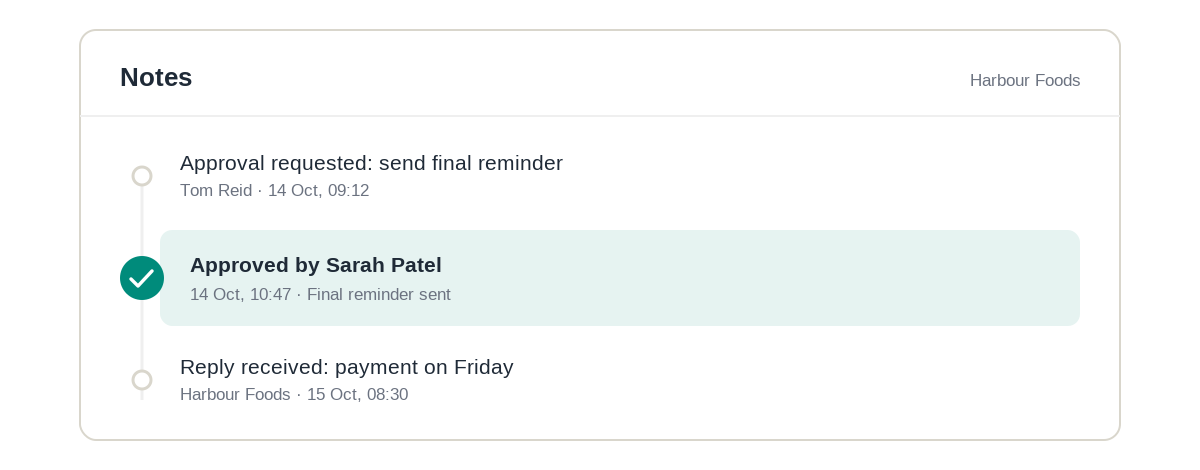
- Approvals. With team approvals on the Advanced plan, Trove records every approval and rejection in the customer’s notes, including who decided and when.
- Reports. Credit control reporting includes saved reports on overdue invoices, debtor health and recently paid invoices on every plan. Recently paid invoices give you a head start on check 5, and if you still build these in a spreadsheet, here’s how Excel debtor reports compare.
- Groups. Multi-entity support on the Advanced plan shows overdue debt across every company in one currency, which helps when you’re preparing a monthly debtors pack as well as the year-end file.
Trove doesn’t post provisions or write-offs. Those decisions and journals stay with you and your accounting system.
FAQs about the year-end debtors audit
What is debtors circularisation?
Debtors circularisation is when auditors write to a sample of your customers and ask them to confirm what they owe. Positive confirmations ask for a reply in every case, and negative confirmations ask for one only if the customer disagrees, which makes them less persuasive.
How do auditors test receivables?
Auditors typically start from the aged list, agree it to the ledger, then test a sample using confirmations, invoices, delivery records and cash received after year end. They also review old balances and the bad debt provision, and check that sales and credit notes around year end are in the right period.
How much bad debt provision should I make?
Make enough to cover losses you have objective evidence for, and no flat percentage on top. Provide for specific balances first, then use your own collection history for grouped small balances, as in the worked provision above.
Can we stop auditors contacting a customer?
You can ask, but you’ll need a reason. ICAEW’s guidance on ISA 505 says a sensitive legal dispute may be acceptable, and the auditor must seek evidence that the reason is valid and carry out other procedures instead.
Does my company need an audit?
For financial years starting on or after 6 April 2025, a private company may qualify for audit exemption if it meets at least two of three tests: turnover up to £15 million, assets up to £7.5 million and 50 or fewer employees on average. A company with about 100 staff fails the employee test, so it would need to meet both of the others, and some companies, including many subsidiaries, have different rules.
If gathering this evidence takes weeks every year, Trove can keep it building all year as you chase. You can start a free 30-day trial here or book a demo if you’d like to see a customer’s history first.